

In the previous post of our Vital Stats series, we explored a known truth about hospital efficiency: OR schedules are notoriously inaccurate, leaving valuable operating rooms idle and underused. While we've pointed fingers at common culprits, such as poor data quality or EHR latency, the challenge has always been to prove exactly where and why these inefficiencies occur across a health system.
Most hospitals focus on high-level metrics: total case time and total turnover time. But these "big buckets" hide the truth. Is the delay caused by setup? Anesthesia induction? Room cleanup? Without detailed, phase-by-phase data, it’s impossible to pinpoint the root cause or define what good or bad looks like.
Five hospitals, one procedure — an experiment in efficiency
To remove clinical variables from the equation, we analyzed lower extremity vascular surgeries — a highly standardized procedure —- across five hospitals within the same health system over three years.
The results didn't just show wide variation; they revealed exactly where the differences happen. This insight is the key to setting clear benchmarks, standardizing processes, and driving measurable gains in OR efficiency.
Check out our ebook on uncovering hidden inefficiencies in the OR.
Download now
Using ambient AI, we automatically captured the median duration of eight key perioperative workflow phases at each site. The difference was stunning. The median total workflow time ranged from 117 minutes at the fastest site to 177 minutes at the slowest. That’s a 60-minute difference for the exact same procedure within the same organization.
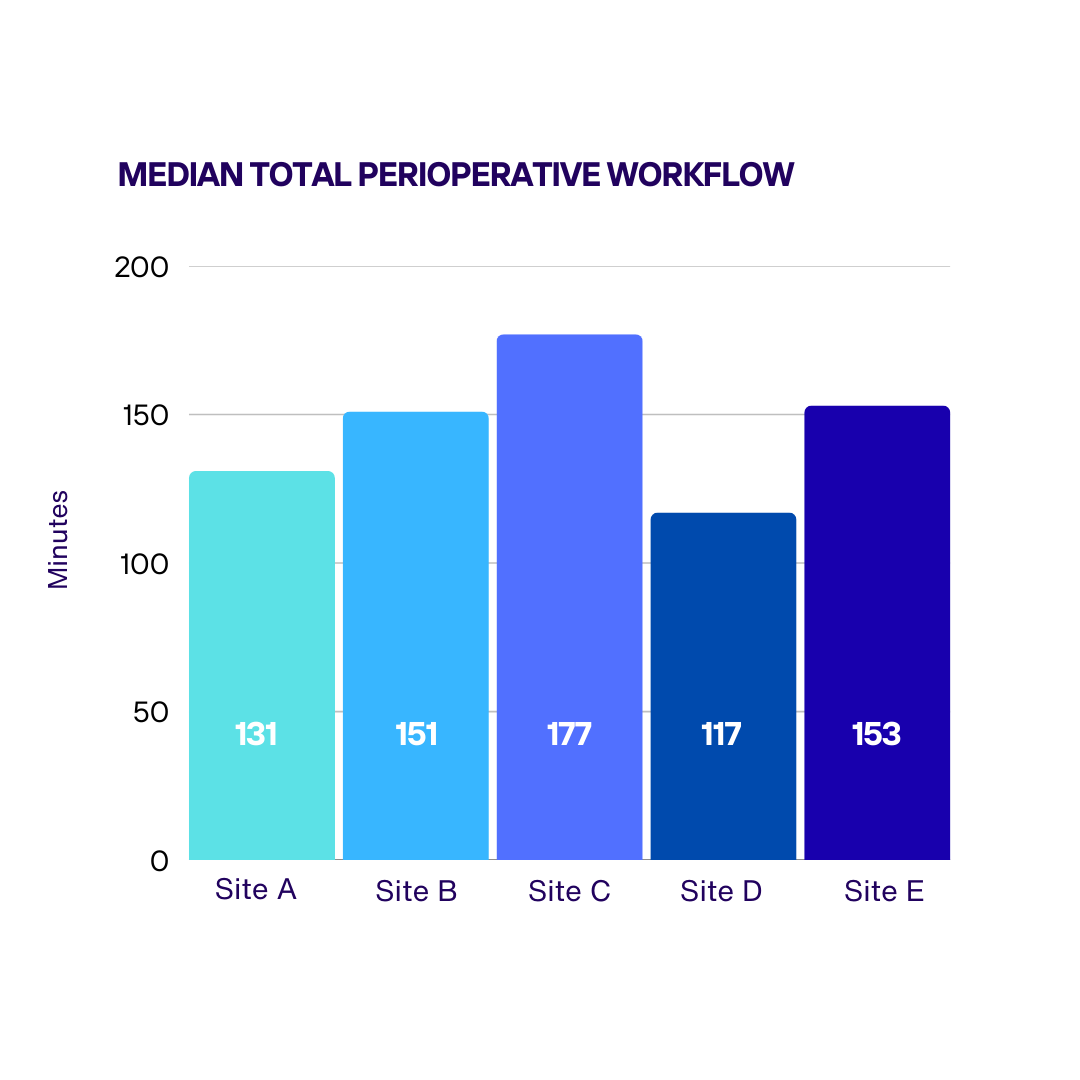
But the real insight isn’t just that there’s a gap; it’s seeing why it exists. By breaking down each phase, we can pinpoint which sites excel in which steps and use those high performers as live benchmarks.
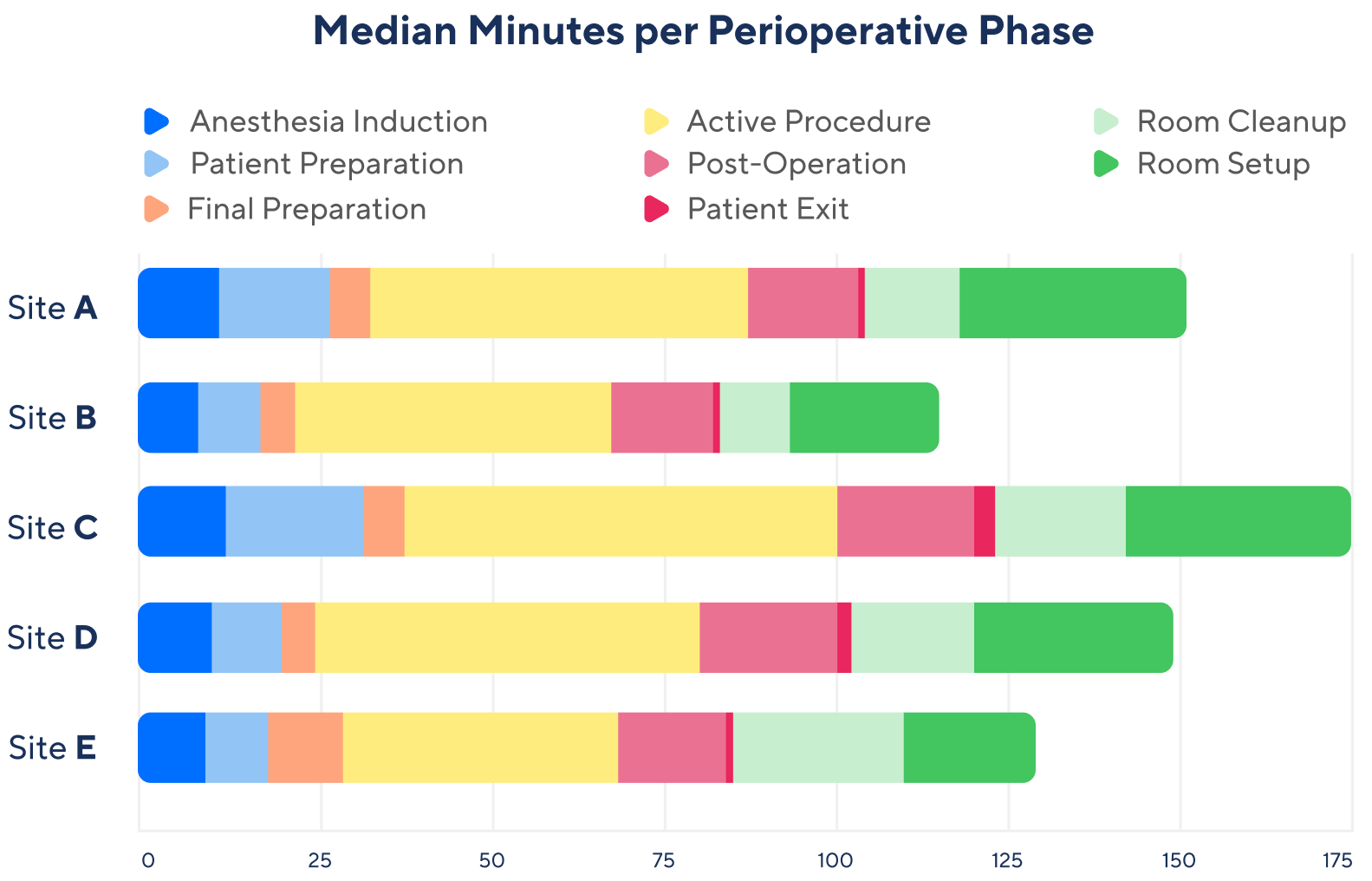
Where the biggest and most actionable gains lie
This analysis means health systems can stop guessing at efficiency fixes and immediately apply the best-in-class standard already set within their own network. While the active procedure time naturally showed the largest range, other non-clinical phases revealed some of the most actionable improvement opportunities:
- Room Cleanup. Median times ranged from 10 to 25 minutes, a substantial 15-minute spread. This is a non-clinical process variable that can be standardized immediately.
- Room Setup. Median times ranged from 19 to 33 minutes, a 14-minute spread that highlights variability in prep time and coordination.
The data also challenged common assumptions about efficiency. For example, the analysis showed that being fast in one phase doesn't guarantee efficiency overall. Site A, which had one of the shortest active procedure times at 40 minutes, also had the longest room cleanup time at 25 minutes. This raises questions:
- Is speed in one phase creating delays in another?
- Are workflow handoffs creating hidden bottlenecks?
With ambient AI, health systems can finally capture every critical workflow phase in real time, eliminating the need for staff to track data manually. This technology identifies the true drivers of variability and provides the blueprint necessary to replicate best-in-class workflows across all sites.
Check out our ebook on uncovering hidden inefficiencies in the OR.
Download now